Ai Weiwei, whose monumental works currently loom large over the hangar-like warehouse space at Manchester’s Factory International, rarely favours a smaller scale. If his art is informed by his experiences, for the most part he chooses not to meet them head on.
Given all that, Sewing a Button, his first durational performance piece in which he compresses his 81 days of detention by the Chinese authorities into 24 hours, some 15 years after the fact, makes for a telling counterpart to the main body of his oeuvre.
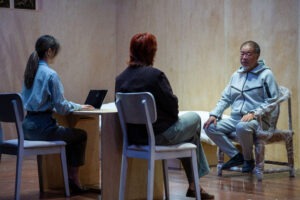
Sewing a Button. Part of Ai Weiwei: Button Up! at Aviva Studios. Photo credit: Hugo Glendinning.
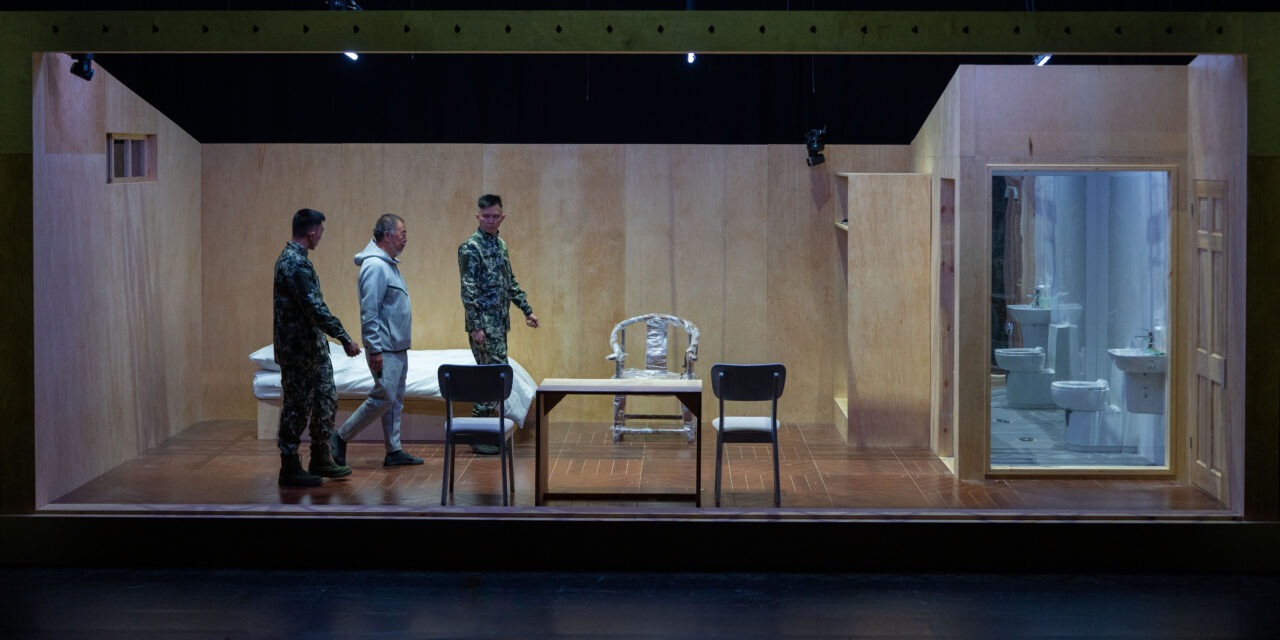
As a partial re-enactment, in many respects it’s at its most thought-provoking when there’s not much happening. The monotony enforced on Weiwei affords the viewer the time to imagine themselves into his sliders. Effectively alone, apart from two guards, each mute with menace, he has only his thoughts to keep him company; no phone, no pen, no paper (and, in real life, for much of his captivity, no button, so that he was forced to hoist his trousers up with his hand). Worse, perhaps, is the lack of privacy, and the particular indignities implied by a bathroom whose walls are transparent. Nor is it that great a leap of the imagination to consider the position of his guards, checking their wristwatches, killing time until their end of the shift. It’s not so much that they’re only following orders, it’s that the consequences of their failing to do so are heavy in their implication.
In the auditorium, rather than the closed-circuit footage which streams the performance elsewhere, the audience are a complication. Proscribed by convention from breaking the fourth wall, they sit complicit as spectators at Bedlam, vying for the best vantage point, clutching their safety blankets of takeaway coffee, feeling the reassurance of muted phones. Unlike the captive Weiwei, they are free to come and go.
The interrogation sequences, of which I witness two, take them out of themselves, give them something else to think about. Each of the two interrogators I sit through adopts a different approach, with notably divergent results. Playing the role of ‘good cop’, Emma Dabiri is the more conciliatory of the pair. Apparently presupposing agreement, her line of soft questioning instead brings out the contrarian in Weiwei. Unwilling to toe the line of any given party, he opts rather for a playfulness that skirts with something more patronising, enjoying himself immensely at the expense of the supposed strength of Dabiri’s perfume. Finally, when called upon to endorse the Black Panthers, Weiwei qualifies his admiration in more explicit terms, baldly averring: “I cannot speak for others. I am not an activist.” This, I think, is the nub of the awkwardness which bedevils the exchanges between Dabiri and Weiwei. Art does not answer questions, it asks them.
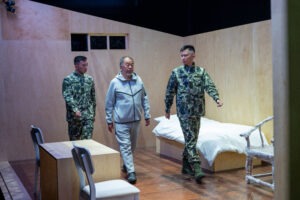
Sewing a Button. Part of Ai Weiwei: Button Up! at Aviva Studios. Photo credit: Hugo Glendinning.
Nihal Arthanayake, by contrast, teeters into camp as a more confrontational ‘bad cop’. It’s a performance that Weiwei appears to respond to, indulging himself in both Warholian paradox (as dry as Noel Coward when he claims that “I think ‘beauty’ is an ugly word”), as well as offering more thoughtful responses. While disavowing his status as an artist, even as he acknowledges the market value of what he produces in his ‘job’, Weiwei seems to be entirely sincere when he protests that “I don’t like any commercialisation, you can’t sell the moonlight”.
When Weiwei goes on to affirm that, exiled as he is from the homeland which incarcerated him, “I don’t accept that I’m a free man”, he echoes, presumably unintentionally, the protagonist of Patrick McGoohan’s The Prisoner, a television series which, ahead of its time, side-stepped doctrinaire dichotomies between the self-appointed ‘free’ world and its single party counterparts. “I don’t think you have democracy in the West,” argues Weiwei. “Not to think about the war in Gaza, and much more to come.”
A moment whose discomfort you can’t scroll past, Sewing a Button ultimately leaves the viewer to consider their own nature, whether they watch with empathy, cynicism or boredom. Never a card carrier for any one political system, nor blinkering himself with blind optimism, Weiwei’s manifesto speaks rather of hope as a kind of tenacity: “we have to believe art always wins”.
On this occasion, it does.
By Desmond Bullen, Chief Arts Correspondent
Main image: Sewing a Button. Part of Ai Weiwei: Button Up! at Aviva Studios. Photo credit: Hugo Glendinning.