There’s an episode of the 90s hit comedy Father Ted where the lads on Craggy Island are visited by Father Damian Lennon, a young Dublin priest and pound-shop Liam Gallagher, who you know is rebellious because he smokes, snarls and, when shouted for, won’t come in to eat his dinner.
When Damo asks the young, cognitively challenged Father Dougal “which one do you prefer, Oasis or Blur?”, he’s left both incredulous and outraged at Dougal’s answer.
This was the question preoccupying Britain in the long, hot summer of 1995, and is the subject of the gripping, visually stunning and splendidly funny play, The Battle, currently running at Manchester’s Opera House.
The play opens at the BRIT Awards in February 1995 where Blur trounces Oasis, winning four awards to Oasis’s one. And in what some saw as a politely patronising acceptance speech, Blur’s Damon Albarn and Graham Coxon sow the seeds of a musical rivalry with Oasis that will spiral into the infamous Battle of Britpop.
The story and backstory of these two rival camps is skilfully told in interviews, dressing rooms, after-parties, recording studios and front rooms, where fights are fought, truths are told, coke is snorted and magnificent music is made. John Niven’s clever and cunning script is delivered with a zealous snarl and a bobo sneer from a cast at the top of their game, and, under the masterly direction of Matthew Dunster, the story unfolds in subtle, yet clear steps.
While the dramatic tension is expertly intensified, the in-jokes and comedic one-liners rattle out with machine gun precision, supressing misery in favour of drama, so by turns you’re laughing and learning, while steadily being drawn ever further into an era-defining rivalry, between middle-class art school artists and unapologetically working-class rock stars.
The brothers grim, Noel and Liam Gallagher, are played by Paddy Stafford and George Usher who do an excellent job of portraying the internal sibling tensions, which initially contributed to the the rise of Oasis and subsequently helped to destroy it. Stafford’s excellent, provocative and thoughtful performance as the moody Manc mastermind showed us an angry, driven young man channelling the beatings of an alcoholic father into the rhythm of a new sound, while shouldering the burden of leadership and the pressure of success and public scrutiny.

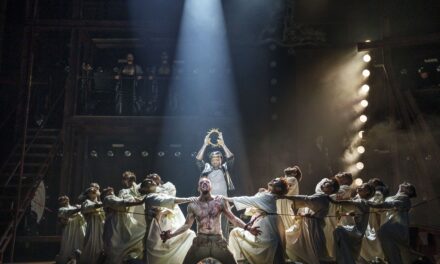
Image credit and copyright: Helen Murray
Usher’s wild, swaggering performance is glorious to watch, though the production is perhaps a little heavy with the idea of Liam being irredeemably thick, given that he evolved into something more nuanced in the following years. Usher truly comes into his own in a long, completely crackers sequence that sees a surreal, hilarious bloodbath/Take That love-in that completely brings the house down.
On the other side of the divide, Oscar Lloyd as Damon Albarn and Will Taylor as Graham Coxon adroitly bring to life the tensions arising in Blur as a result of wanting to be seen as both pop stars and artists. Taylor portrays Coxon’s anxieties and doubts and the beginning of his descent into depression and alcoholism with great pathos, while still managing to make the audience laugh like drains. And Lloyd really gets under the skin of the aloof Albarn, peeling away the layers of a man re-evaluating in real-time his innermost drives and desires.
Special mention must be made of the depth and range of the performances by Louisa Lytton and Harriet Cains. Both had dual roles within the play, and so deeply committed were they that I failed to recognise they were each playing two consequential roles.
In her role as Meg Matthews, Lytton pours oil on the troubled sibling waters, helping to delay the inevitable split, and Cains as Justine Frischmann gently helps her partner Albarn to accept the realisation that he will never be the working-class hero that Noel has become: “He speaks to them…you write about them.” The power of Niven’s words are skilfully enhanced by these accomplished performances.
In all of this, the cast is superbly supported by a creative and production team that delivers first-class results. Graphics, music, sets and lighting are all turned into charters in their own right, with everything from balletic set changes to a nostalgic, weaving soundtrack combining to create a truly special atmosphere.
This was a performance that shocked the audience into silence, had us laughing like policemen, and cheering like ultras during a standing ovation. If anything deserves a long run in West End, it’s The Battle.
Main image: Credit and copyright Helen Murray.

The Battle is at the Opera House, Manchester until March 21, 2026