They used to call this place Tatty Dock.
That was the name Chris Bonner used, almost in passing, standing in his bookshop Hold Fast on a repurposed coal barge moored across the water. Potatoes — mountains of them — once passed through here, and kids would dive into the navigation to grab the loose spuds floating past. Fallen from sacks, fair game. Cold water, sharp edges, real risk. Northern pearl diving.
It’s hard to square that image with the first sight of Leeds Dock now: crisp lines of glass and steel, clean walkways, water behaving itself. But this place has always been layered. Scratch the surface and older stories rise quickly, not as nostalgia, but as working memory. Chris told the story because everyone knows it. Because people here still know one another.

Photo by Rebecca Murray
Fearns sits right in the middle of that tension. An inland dock that still feels faintly improbable with a brunch spot anchored at the end of the Leeds & Liverpool Canal, that long ribbon threading labour and trade across the North. Most of the buildings here aren’t warehouses reborn. They’re new, open, carefully designed. But the dock doesn’t feel hollow. It feels inhabited, a small ecosystem of businesses that recognise one another, speak fondly of one another, pass people back and forth across the water.
What hits when you walk into Fearns is the scale. The first encounter is cosy enough, but beyond that the space opens out into an atrium-sized, almost cathedral-like expanse. This matters. These huge volumes don’t just generate awe, they produce a particular kind of privacy. The opposite of closeness. Here, distance allows people to exist alongside one another without interruption.
As we settled, the space broke into small vignettes with laptops everywhere, silver shields and headsets making the work remote. People weren’t lost, though. They looked up and there were others. We need spaces like this now, places where the digital and the breathing worlds can sit together. Not everywhere allows it. The Artist (my dining companion) and I talked about places we know where opening a laptop would feel like lugging in a sewing machine, a lathe, an easel. Here, machinery was the norm. Every machine fruit-branded, brushed silver. Mine too. Bring elsewhere with you, and you belong.
The building itself used to be a casino, a detail that reveals itself slowly. A glitter ball hangs above the room, not ironic, not kitsch, but more like an echo. Risk, indulgence and money have always circulated here, they’ve just changed costume. Along one wall, a long bar of pale wood and bright light stretches out with quiet promise. Look up again: a smiling barista, the manager moving through the room with warmth, reminding us not to let our food go cold.

Photo by Rebecca Murray
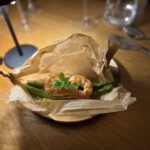
Food here isn’t the main event, but nor is it inconsequential. It understands that the day may be about other things: work, meetings, catch-ups, dockside wandering. Fish finger sandwiches and harissa cauliflower flatbreads sit easily alongside cocktails and coffee. Food for eating, not flattering. We ate simply, but well. The Hot Honey Chicken Flatbread did exactly what it promised, sweet heat, no theatrics. The kind of plate that disappears before you’ve thought too hard about it. Meanwhile, the Veggie Breakfast was solid and generous, properly sustaining rather than decorative. We shared a Banoffee French Toast, warm and unshowy, the sort of thing that makes sense in a place where people plan to stay. Coffee came and went as conversation stretched, food doing what it should do here: holding the day together without demanding centre stage. Around us, babies in tank-like prams, a yapping dog, furrowed brows over screens, laughing groups in business suits, solo makers and creators. No sense of interruption. Everyone in their own world, held together by the generosity of the space.

Photo by Rebecca Murray
We discussed the possibilities of the for-hire cinema upstairs, the strange open corporate duality of passing a reception desk before taking your table or settee. It is work, just not as I know it. Outside, the dock air pulled us toward the Canary Bar — Fearns’ shipping-container sibling, painted bright yellow, described as the ‘naughty little brother’. Rooftop spots for brighter days, snug corners for gun-metal grey ones like this. Instead, we crossed back over to the coal-barge bookshop. Working-class life, mysticism, outsiders. Chris spoke warmly of the people at Fearns, of the dock as a place that works because people talk.
The past plays out around here as glitter balls and lost potato divers. The pearls are earthier now, no less treacherous to chase. Work and leisure sitting cheek by jowl, as they always have.
Like those pearl divers, slipping under the surface alone, you go down by yourself. You work. You take the risk. But when you come back up, you’re a little richer. You see the faces of others. You recognise the purpose of the thing. And you share the real treasure of the day.
A smile.
Main image by Rebecca Murray

££
For more information about Fearns, click here.