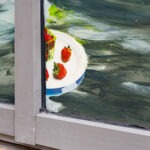
Steady in its ways though it might seem now, as recently as 1866 the River Irwell rose beyond its bounds in Lower Broughton, flooding much of the area including the then recently-instituted Peel Park. Rising to heights of more than eight feet, it would – to say the very least – have inconvenienced the residents of Lark Hill Villa, the building which stood above the park and now houses Salford Museum and Art Gallery.
This proximity, both historical and geographical, makes the gallery a particularly apt setting for a second iteration of Liam Spencer’s Irwell: Afterlife, the exhibition having first appeared in a somewhat different guise close to the headwaters of the river in Rawtenstall’s Whitaker.

Credit: Liam Spencer
Spencer himself is closely connected to the 39 miles of its watercourse, an affinity forged in both home and studio across the years. His work is, to a large extent, a celebration of the Irwell’s recent rejuvenation. What was once an industrial waterway has gradually recovered as the towns and cities it flows through have become post-industrial, their capital no longer accrued through milling, manufacturing and shipping. In some ways, its neglect, in terms of accessibility and commercial usage, has been benign; allowing nature, abetted by improvements in sewage treatment, to once more find its way.
Navigating the gallery space counter-clockwise, one is greeted by a delicate gathering of birds of many a feather. As elegant as calligraphy, they break the thread with the bus corridor bustle of the A6 outside, lulling the visitor into the backwater gentleness of the exhibition itself.
For me, however, the triptych of flat screens entitled A River Reborn, across which Spencer shows a series of short films, themselves documenting video clips of river life projected against a series of still lifes, seems to work against itself. While the accompanying soundtrack tends to the contemplative, the profusion of images is oddly discordant, decidedly man-made.
Aptly enough, the videos cluster between a series of broader stroke oil paintings, delineating in the main just this abutment between the brick-built and the river-nourished. Caught seemingly at dawn or dusk, when the sun uses its palette to paint the world in shades of red and shadows like the glass of high-rises, the best of them – notably Edenfield Bypass Bridge – pick out the utilitarian beauty in the structures that presume to edge out the natural.

Credit: Liam Spencer
By way of contrast, the purple washes of The River Was The Colour Of Vimto allude more playfully to the polluted river courses of the last two centuries, but also to the Manchester invention and Salford manufacture of what was originally marketed as a temperance drink and health tonic. Pinkish prettiness notwithstanding, its effect arises from this essential ambivalence as to whether humanity’s presence colours the world or discolours it.
Closing out the space, Spencer’s Irwell Patchwork stitches it all together. Made up of a number of square-ink drawings, each little larger than a bathroom tile, it brings to mind a more orderly periodic table, each element a facet of the river, its life and the human imprint. Dead centre is a monogram formed from his own initials, a small flourish that seems to acknowledge that his is one of any number of vantage points from which the shifting, living waters of the Irwell can be seen.
See for yourself.
By Desmond Bullen, Chief Arts Correspondent
All images: credit Liam Spencer

Credit: Liam Spencer
Irwell: Afterlife by Liam Spencer is at Salford Museum and Art Gallery until September 7, 2025. For more information, click here.