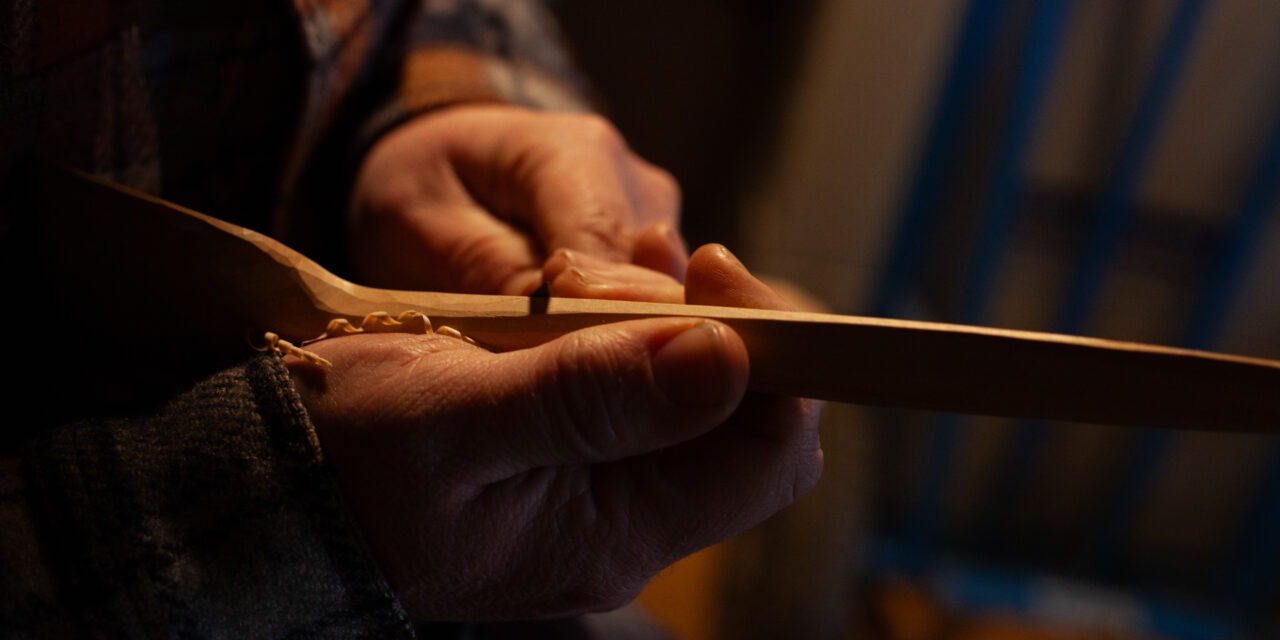
Just after I arrive to interview Nick Vorstermans, the woodworker who has carved out a corner for beautiful things at Studio Critical: in Chorlton, a couple walk in and I witness an exchange that exemplifies the way Vorstermans works. He has lovingly repaired a small axe and, as it’s handed over, the owner weighs it in his hands, appreciating the unusual stadium cross section of the new handle. It is traded for the promise of one kilo of specially roasted coffee beans to be delivered in the coming weeks.
Dressed in cosy shades of orange, from his fuzzy checked jacket to his knitted beanie, Vorstermans looks every inch the Canadian. As he grinds coffee beans, Vostermans explains how the transaction emerged from dovetailing needs – a usable axe to cut kindling and a coffee addiction.
“It took me longer than most people want to pay to do a little handle,” he says, as grounds pour into a wooden container. “You can buy a cheap second-hand axe for way cheaper than it takes me, but that’s not the point.” 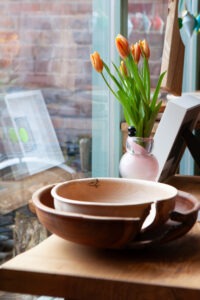
Vorstermans’ work is relational; the curve of each creation draws lines connecting people and place. “We talk about it a lot in a funny way, like I’m having lunch with Dan and Jim, meaning the bowl Jim made and the spoon Dan made. There’s this lovely connection. Every time I use a spoon that I bought from someone else, I think of that person.”
This is a world away from his original training as a cabinetmaker in Vancouver. “When we moved here, I was pretty burnt out on luxury Vancouver clients who have lots of money but you never meet the person,” he says. “So you get to make amazing things, but the end result is you hand it over and they’re just like, here’s your money bye. You never met them and talked to them or had a cup of coffee at the table you’ve built. There was no connection.”
A new direction
It was his Master’s in design that led Vorstermans to re-examine his practice and approach to craft.
“That’s what got me into thinking about how we interact with the objects I make,” he explains. “Furniture’s great, but we often have a really practical way of interacting with furniture. It’s just there. It’s literally the furniture. I was thinking more about how we share objects…if you make a bowl, it’s made for sharing.”
He also reconsidered the material itself, starting to follow the way the wood resists or redirects his intentions. “I trained originally in such a controlled environment with big machinery and it was like making the wood submit. I draw on some of those techniques, but I’m much more sympathetic to the material.” For example, if a future spoon handle resists a line-following axe blow, he allows himself to be led along new strokes by the wood instead.
Studio Critical. Photo by Rowan Twine.
Vorstermans discovered the joy of spoon-carving after he became a parent. As he wheeled his daughter around Chorlton, he collected little pieces of wood in the pram, fitting carving into the small slices of time left between being a new parent and earning a living.
This shift led to an epiphanic new way of eating. “I’m an adult and I’m having a new experience with eating that is textural, it’s a sound. A wooden spoon is silent on the bowl, or if you hit your tooth. It feels different in your mouth.”
He continues: “You can feel the way the spoon is slightly uneven. It doesn’t get hot the same way. There is a completely different experience eating with wooden things in general, plates, everything.” Now, Vorstermans only has his toast off wooden plates, keeping ceramic for other things. And his collection of spoons keeps growing. Laughing, he says: “I kind of jokingly tell people the best part about using wooden objects is you have to wash them up so you get to spend more time with them.”
His spoon-carving often fills the slithers of time between larger projects, and some of his favourites are collaborations with chefs. “I’ve done really bespoke stuff for these Michelin chefs, which is amazing because they come in with this spark in their eyes about this dish they’re envisioning and then you’re helping them plate it.” 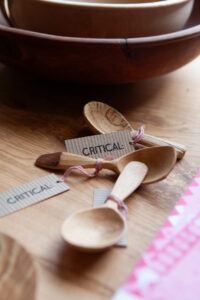
Vorstermans sees the pieces as shared creations, emerging from the creative visions of people from different worlds. You can find Vorstermans’ work around the country including at Michelin-starred sō-lō in Aughton, Treehouse Hotel in Manchester, and The Walled Gardens, the vegetarian experience by Eddie Shepherd in Whalley Range.
A critical craft
Sitting on one of his own handmade stick chairs, Vorstermans describes how he created Studio Critical:, his shop and studio in Chorlton. The ‘Studio’ element references the range of activities that he explores, from furniture-making to workshops, while ‘Critical’ is part of his practice.
“I’m a critical person in a lot of ways,” grins Vorstermans with a warm chuckle. “I’m politically engaged, I’m critical of the woodworking world from a political side, like using wood from across forests in war-torn countries, like disposable furniture.”
Although he acknowledges that craft wasn’t traditionally a means of protest, he believes that is no longer true today.
“In the modern world of production and factories, making something by yourself in a minimal way is a protest because you’re going against everything that consumerism and capitalism tells you to do. If you want to call it craft, you have to be considering the material, it needs to be human-focused, it needs to be at a human scale, and all of these things make you look at every little detail and consider it.” These considerations infuse ethical working throughout his work, from collecting wood from locally fallen trees on his bike to taking his wood chips to nearby allotments.
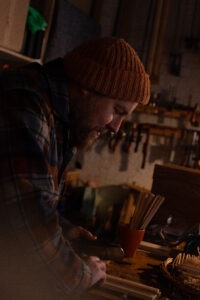
Nick Vorstermans. Photo by Rowan Twine.
Finally the colon (the brand name Studio Critical: has a colon at the end) which allows space for all possible interpretations of his work and comes with an added counter-cultural bonus when he writes his business name on forms. “What I love about it is it will not be accepted in any online form. They’re like a bureaucratic rejection of what I’m doing, it’s really symbolic and I had no idea, but I love it every time it happens.”
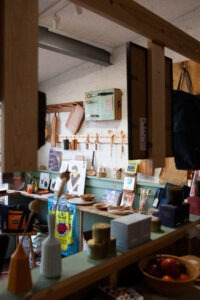
Inside the shop itself, there is everything from bright, printed posters to delicate silver jewellery and locally roasted coffee. Part of this choice was purely visual. “A woodworking-only shop is very beige. Aesthetically, if you don’t like wood, you’re going to turn around immediately.” However, this decision goes far beyond simple appearance.
Vorstermans explains: “I’ve got to where I am in craft through the help of other makers. You have to be collaborative with people I think. So these are all people who I’ve known in the last five or six years through the craft world. It’s just nice things that are nicely made by people who care. That’s what it’s about.”
Words and pictures by Rowan Twine
Studio Critical: is open Friday 8.30am to 5pm and Saturday 10am to 4pm. For more details, click here.