To misquote Jane Austen: ‘Prizes are foolish things. The pleasure is not enhanced, and the inconvenience is often considerable.’ The prose stylist against whom all who have come after must measure themselves may well have been considering surprises, but the paraphrased observation still bears up to scrutiny.
Art, arising as it does in the space between the artist and the audience, is resistant to ranking. The idea that it can be reduced to definitives, from best to worst, is as absurd as the claim that the winners of the Mercury Prize have recorded the year’s greatest new music. Or that the annual Academy Awards anoint the films that will stand the test of the next 12 months, never mind the ages.
In the Turner Prize’s defence, it is something more than the afore-disparaged glorified trade shows, foisted on the public by a lazy press complicit with the hype of the music and motion picture industries. If the crowning of the Turner’s winner is somewhat beside the point, the attention it gathers is not; all the more so when the accompanying exhibition manages to prise itself away from its Oyster Card comfort zone, and beyond the black hole of London’s vanity mirror. It’s telling that all four shortlisted artists, whether born in Peterborough, Glasgow, Vancouver or Baghdad, currently live and work in that capital city.
On the face of it disparate in their practices, if this year’s nominees can be said to share a commonality beyond their adopted conurbation, it’s the incense-perfumed essence of first-term halls of residence, when identity is refined and written large.

Rene Matić. Turner Prize 2025. Cartwright Hall Art Gallery, Bradford. Photograph by David Levene,
This is most apparent in the works of Rene Matić whose art speaks most clearly to the disquiet of recent times, in which otherwise blameless streets have been disfigured by an outbreak of ambiguous bunting, metastasising from lamppost to lamppost under the false flag of patriotism. Anticipating this double-edged nationalism, and meeting it head on, is a flag of Matić’s own devising. On one side, the untitled piece reads ‘No Place’, on the other ‘For Violence’; an elegant compression of a host of competing ideals, both counterpoint and critique to the hypocritical rhetoric of Republican mouthpieces in the aftermath of the attempted assassination of Donald Trump. This, and Restoration – a black dolls’ orphanage giving a home to the broken and abandoned toys Matić has rescued over the years – crackle with the energy of great art’s resistance to words. Sadly, the same cannot be said of their Feelings Wheel, which strikes the eye as being, at heart, a larger scale version of the clip-framed collages of a thousand student dormitories.
Zadie Xa’s installation, while forming a more coherent whole and despite its reflective floor, conveys only the illusion of depth. Encountering its apparently deadpan appropriation of New Age tropes – including but not limited to whale song – is like immersing oneself in the cover art of more complicated magpies of the one-time counter culture like the archly sincere Magdalena Bay. It’s undeniably delightful, a snack for the senses, but as evanescent as joss sticks.
If Xa is in alignment with the hippies at the Freshers’ Fair, and Matić’s culture is multiple and queer, then there’s something of science fiction cover art in Mohammed Sami’s paintings, like panels from a graphic novel wordlessly depicting the stillness after unimaginable violence. Most were originally exhibited to be at odds with the vainglory of Blenheim Palace. Adrift from their contrast, they seem a little muted.
There’s more of a sense of release in Nnena Kalu’s whirlwind drawings, vivid with the electricity of being. It’s a shame, then, that her sculptures felt like the opposite; their accretion of materials mummifying what life they might once have possessed, so that they hang unprepossessingly, like so much dead weight.

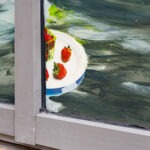
Mohammed Sami. Turner Prize 2025. Cartwright Hall Art Gallery, Bradford. Photograph by David Levene.
Matić, perhaps, in connecting to the moment – Charli XCX in her sound sculpture and all – is, if not the best, then the most essential of the nominees, her more fully-realised pieces osmosing beyond the gallery walls and into the real world. They are, in the least pejorative sense of the word, accessible to the casual and the curious, coaxing them into the realisation that art is a conversation they can be part of, and contribute to. It’s not just for London, not just for critics with a penchant for scattershot cultural references and abstruse vocabulary; it’s something that can be prised away from the gatekeepers and simply prized. In that respect, at least, everyone’s a winner.
By Desmond Bullen, Chief Arts Correspondent
Main image: Installation view of Zadie Xa’s presentation at Turner Prize 2025, Cartwright Hall Art Gallery. Photo © David Levene.

The Turner Prize is at Cartwright Hall Art Gallery, Bradford until February 22, 2026. For more information, click here.