There’s an art to parting, a chance to frame the end credits on one’s own terms.
As it metaphorically draws up its secret bridge and takes its leave from its Castlefield home of nearly a decade, Saul Hay Gallery makes an exit with no small measure of aplomb. 10 x 10, its closing bow, elegantly sidesteps the cheap allure of trading on nostalgia by being both retrospective and prospective; 50 artists who have previously exhibited in its space at Railway Cottage in Manchester have each invited one other who has never done so, and all are confined – more or less – to 100 square centimetres of wall space.
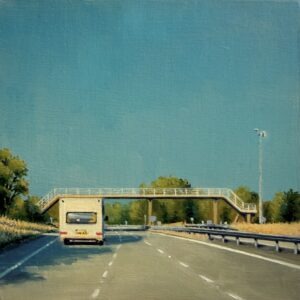
A Very 70s Summer by Jen Orpin
Numbered rather than named, there is a wonderful equivalence in their hanging, severing as it does reaction from reputation. Inevitably, some of the artists – the likes of Jen Orpin and Mandy Payne, for instance – are readily identifiable. Nonetheless, gallerist Ian Hay’s commitment to democracy invites a closer look, revealing riches among the renowned and the less well known.
My own dark-adapted eye was drawn, with thematic aptness, to those works which shed light on light’s passing. Alyson Barton is on record as acknowledging that The Luminous Veil owes much to the mourning that followed her mother’s death. Certainly, the piece balances a crepuscular quietness with the ambiguous light of a sun that may be either returning below the horizon or ascending above it and, in doing so, intimates a kind of faith. It reads like a prayer rendered in chromogenic silver halide. The Gentle Quiet Of Memory, on the other hand, owes its sense of disquiet less to Deborah Grice’s palette of oil and gold than to the lines of focus that score across its view, like gunsights cropping the landscape, honing in on a kill.
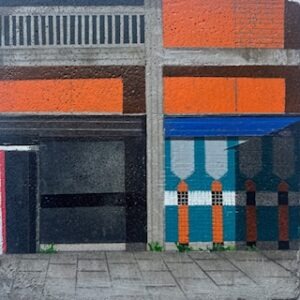
Park Hill Shadows by Mandy Payne
Contrastingly, rather than invoking the manmade inhumanity of A.I. guidance systems, Tom Musgrove’s Entertaining Doubt seems to pulsate with a more supernatural shade of darkness, as though its cuboid form has been extruded into our existence by the tainted inhabitants of David Lynch’s Black Lodge. The waxen symbols which mark its visible faces, as though traced in still-fresh ectoplasm, evince the half-familiarity of some occult language. If the sculpture resembles a die, it is one that is almost certainly loaded against us.
The potency of the best of Lynch’s work lies in its ability to suggest a porousness between the nightmare irrationality of sleep and the comforting routines of waking life. In his The Last Days Of The U.S.A., Iain Andrews ingeniously evokes the daylight darkness at the heart of the present day White House, taking the still-curling edges of an opened and flattened Coke can as his aluminium canvas. Shunning the more obvious hues of the Book of Revelation, while taking its cues from the storm fronts of John Martin’s apocalyptic weather, Andrews’ seasick greens illustrate all too queasily the Biblical verse that warns of the final (T)rump.
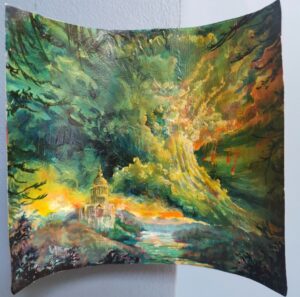
The Last Days of the U.S.A. by Iain Andrews
Not, of course, that all in the exhibition is gloom and doom. Andy Smith stands out, not just for laying down his parallel lines on a block of mahogany that does exactly that – jutting into the gallery space from its place on the wall – but in utilising the edges of the extra dimension his choice of material affords to add extra depth to his cityscape. Consequently, Bridge View, Oxford Street, its forms emerging in threads of differently coloured oils that act like the warp and weft in his depiction of the 21st century Cottonopolis, solidifies the light just as convincingly as his peers summon its opposite.
These few pieces hardly scratch the surface of the exhibition’s abundance. Indeed, with such a final curtain to its credit, the prospect of Saul Hay leaving behind an empty stage feels all the more difficult to contemplate. In providing a physical space, a coordinate in space and time, the gallery became a quiet catalyst, a meeting point where the cultural trajectories of music, literature and art could conjoin and ignite. While Hay has plans for the gallery’s regeneration, in both virtual and physical forms, for now, even with Midsummer having just passed, the impending absence of its spark leaves Manchester feeling a little colder.
By Desmond Bullen, Chief Arts Correspondent
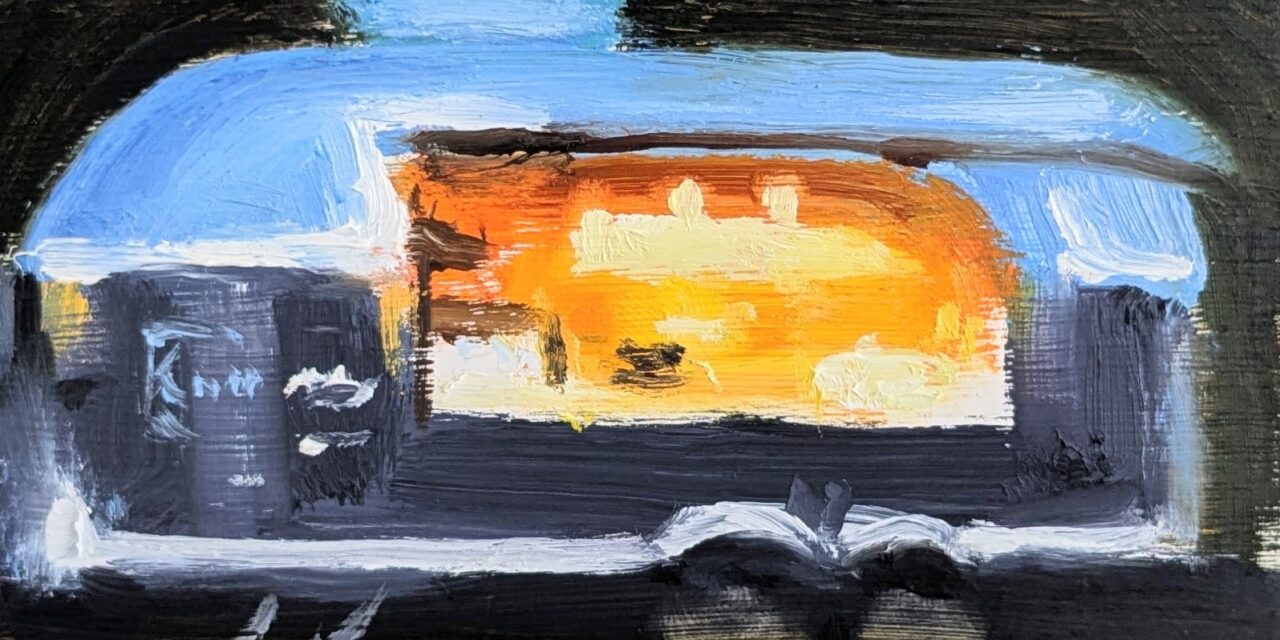
Main image: Chippy Van by Liam Spencer