When an opera production is revived 32 years after its premiere, does it still shine or is it covered by a layer of dust? The celebrated director Phyllida Lloyd’s production of La Bohéme for Opera North, which resituates Puccini’s tale of 19th century student life, love and penury to the 1950s, certainly hasn’t lost its youthful charm, as this season’s sparkling revival shows.
I last saw it in its original run back in 1993 when, like the opera’s protagonists, I was an emphatically immature mature student, complete with hard times, damp housing and bad coughs. Since life imitates art, I was even running to a clumsy, on-off and intermittently torrid romance. I saw it then with a group of student friends, all new to opera, and we loved it then. I still admire Lloyd’s 1950s setting, where post-war austerity meets bohemian vitality and romantic urgency vies with a fiscally broke yet booze-fuelled hedonism. Something in that mix must, I guess, have spoken to our younger selves. We were a tight crew, or thought we were, yet spool forward a few years and we’d all grown up and gone our separate ways.
It is often said that La Bohéme is the perfect ‘first opera’ to see. The Lowry’s website recommends it to seasoned opera-goers and to those who ‘are dipping …into opera for the first time’. I can see why. It is intimate, manageable, not over-wieldy and recognisably about young people and the loss that can come with maturity. Its immediate appeal is also down to the music, of course.
Things in this revival begin in a knockabout way with a quartet of starving artists. The poet Rodolfo (Anthony Ciaramitaro), painter Marcello (Yurly Yurchuk), musician Schaunard (Sean Boylan) and philosopher Colline (Han Kim) are burning one of Rodolfo’s manuscripts to keep warm and have just enough cash for a Christmas Eve meal. Rodolfo is briefly left alone when an ailing neighbour Mimi (Olivia Boen) taps on his door asking for a match to light her candle. Love, of course, blossoms in an instance and the first act hits us rapidly with three of the most heart-wrenching melodies in opera – Che Gelida Manina (What a frozen little hand), Mi chiamano Mimi (They call me Mimi), and O soave fanciulla (Oh lovely girl) – while conductor Gerry Walker expertly captures Puccini’s exquisite scoring from his brilliant orchestra.

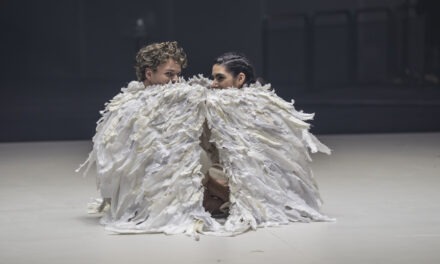
Image: Opera North’s La Bohéme, courtesy of the Lowry
Ciaramitaro’s strong yet delicate high notes sail over the orchestra pit, and his performance brilliantly nails the character’s wide-eyed naivety, his poorly managed emotions, and occasional laddishness. And it’s hard to imagine any better casting than Boen for the role of Mimi – she’s slim, delicately vulnerable and yet knowing and sharp. As tuberculosis weakens Mimi and the final act delicately reaches its inexorable conclusion, things are all too weepingly believable. In just four short scenes marking moments in the arc of a romance, Puccini takes the stuff of ordinary if precarious lives and makes it epic. Harsher critics have sometimes dismissed his work for lacking the complex, weighty Grand Themes, the convoluted storylines or the more ‘difficult’ modernist music that certainly can loom intimidatingly in the opera house. Such critics deliberately miss the point. What’s not to love?
The designs by Anthony Ward are slick and efficient. His sets allude to mid-century cinema, to Warholian pop art and to a Paris that seemed to exist 40 years before the production’s first appearance in the 1990s. Tellingly, Puccini’s 1890s opera was based on an episodic novel of bohemian life written four decades earlier and set in the 1840s. Ward has contained his sets within a crisp white frame, brilliantly evoking a sense that these four vignettes are like polaroid snapshots, records of youthfulness, friendships and loves that have now faded into a remembered or perhaps forgotten past.
There are moments of sheer directorial panache: as act one’s affair between Rodolfo and Mimi bursts into life, a screen masks the ramshackle garret and the pair’s duet is poured out gloriously under a huge full moon. The young at heart really don’t mind sentimental moments like this. Meanwhile, act two’s crowded café scene makes full use of a stage revolve that cross-cuts between vibrant street life and our protagonists’ evening meal. Special mention here goes to Elin Pritchard as Marcello’s recent ex Musetta. Marcello tries in vain to ignore her as she fleeces her latest elderly sugar-daddy (and Yurchuk’s/Marcello’s smoky baritone is a highlight of the evening). When Pritchard sings Musetta’s set-piece aria Quando me’n vo (When I go) – as flirtatious a waltz as has ever been penned – his resistance entirely evaporates.
With such a strong opening act and the turbo-charged seductiveness of Musetta’s Waltz in act two, productions of La Bohéme can struggle to maintain their momentum after the interval. Here, though, there’s an astonishing and clear-sighted intimacy that carries things through to a conclusion that is nothing short of devastating.
By Andrew Moor, Opera Correspondent
Main image: Opera North’s La Bohéme, courtesy of the Lowry