It’s the most famous heckle in history. Around 9.30 on the evening of May 17, 1966, a disgruntled punter on the balcony shouted “Judas!” at Bob Dylan, towards the end of the second half of the latter’s gig at Manchester’s Free Trade Hall. Also in the audience that night was 16 year-old Dylan fan Chris Lee from Didsbury.
Later in life, by then known as C.P. Lee, he’d become a musician himself, as well as an esteemed chronicler of the Manchester music scene. In 1995 he would write a PhD thesis on the subject, thereby becoming Dr C.P. Lee (or, if the mood struck him, ‘Dr Rock’). Lee drew on his memories of Dylan’s Free Trade Hall gig for a chapter in his PhD, later expanded into a full-length book, Like The Night – generally considered to be the definitive word on the subject – first published by Helter Skelter in 1998.
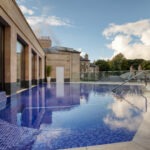
The times, they have a-changed. The Free Trade Hall, built on the site of the Peterloo massacre, is now a Radisson hotel. Sadly, C.P. Lee left us in 2020, at the age of 70. We’re coming up on the 60th anniversary of that legendary Dylan gig, and to mark the occasion, fine Pontefract-based publishers Route are reissuing Lee’s book in a brand-new edition, Like The Night (Rebound).
“I love this book more than any other book on Bob Dylan,” says Ian Daley, founding editor of Route. “As I always say to anyone who’ll listen, it’s not really a Bob Dylan book, it’s a Manchester book. You can’t tell the story of Manchester music without this. It’s treasure for us, absolute treasure. I think we were destined to cross paths with it.”

Photo credit: Mark Makin
The reasons for that “Judas” heckle were wrapped up in Dylan’s status as a worshipped hero of the folk music scene of the time – a more authentic reaction, some would have said, to the pop onslaught of The Beatles and their ilk. On that tour, though, Dylan delivered a set of his songs solo, before plugging in an electric guitar and bringing on a backing band.
Daley explains: “Bob was seen as part of this left-wing folk revival movement that shunned commerciality and was collective. They saw him as a betrayer of that by picking up the electric guitar and doing what they consider to be commercial pop music. They felt like they owned him, and they were very upset by him.” Sure enough, film footage from the gig’s immediate aftermath shows one very Lancastrian-sounding audience member declaring that “it was a bloody disgrace, he wants shooting”.
Of course, there’s far more to this story than just one shouty punter. Dylan and his music really mattered to people – hence the outburst – and arguably his ‘going electric’ only presaged him becoming even more influential, more important. In a way, then, the Free Trade Hall show captured a key moment in the history of popular music.
Manchester
For a time, Manchester’s exact role in this momentous occasion was obscured. The cry of “Judas” became well known, though initially due to a bootleg of the gig erroneously credited as coming from the Royal Albert Hall in London (actually, the Royal Albert Hall hosted a later show on the same tour, which is where the recording of the Manchester show was to be delivered once processed by a recording studio: that’s why it was labelled ‘Royal Albert Hall’, and that’s why the subsequent bootleg was mislabelled).
That’s before we even get to the thorny matter of exactly who it was that shouted “Judas” on the night. By the time Lee was involved in the making of Ghosts of Electricity, a 1999 BBC Radio documentary on the subject hosted by Andy Kershaw, two entirely credible culprits had came forward, and debate still rages as to which one was the real deal.

C.P. Lee. Photo courtesy of Route.
All of these aspects are covered in Like The Night, with Lee combining groundbreaking research with a personal touch – after all, he was there. Daley is hugely admiring of everything the book achieves, right from the very start – namely a fictionalised account of a journey Dylan took with his manager on an earlier trip to Manchester, from the city centre into the suburbs. “That opening chapter, where he takes Bob and Albert Grossman from the Midland Hotel and drives them down Oxford Road, through Rusholme, into Withington, into Didsbury, into Chris’s own village, is just sensational. It’s just so evocative.”
Daley’s own love of Dylan knows no bounds. Route have published a whole swathe of acclaimed books on the subject, and he can well recall how Bob Dylan first came into his life. As a boy growing up in the coal-mining town of Featherstone, Daley noticed the songwriting credit ‘B. Dylan’ cropping up on the Joe Cocker albums his dad played. That inspired him to dabble in Dylan a little, but when he was around 15, his parents returned from a holiday with a present for him: a copy of Dylan’s 1965 album Bringing It All Back Home. “I put it on,” he recalls. “It was summertime, and I can still visualize it, playing that and it just knocking my head off.”
Before long, Daley was a full-on, devoted Dylan fan. “Until I was into my early 20s, I would listen to nothing else,” he says. “Just complete Bob, total, total Bob. He just brings everything together. Through Dylan, I went to the Beats, I went to 19th century Romantic poets. Everything that he brought in, I went out and found. Also, I lived in a coal mining culture. Chris nails this in the book: what Bob Dylan does to a Northern English man. Chris said that it was very difficult for him to get out of Manchester in the 60s, but that you could escape in your mind. That’s what Bob Dylan encourages, and that’s what Bob Dylan facilitates and that’s what happened to me. There’s nothing more accurate about what Bob Dylan did to me. The use of language to liberate your mind, nothing has had that impact on me. The reason I am publishing books now is because of that. Bob Dylan gave me everything, literally everything.”
C.P. Lee
Pam Malden, on the other hand, was 14-years-old in May 1966. At the time, she was a pop music fan with an older brother studying at King’s College in London.
“The Who, the Small Faces, those were the gigs I was going to,” Malden says. “I’d be watching The Monkees and my brother would be so snobby. He’d say ‘oh, pop is so rubbish, you’ve got to get into Dylan’. I was told it was much deeper music, deeper, better. Older siblings are always going to be on at you, aren’t they? But there was pressure from everybody’s peer group. You had to be into Dylan.” Malden soon acquired a taste for his stuff, though, expanding her tastes beyond pop. “I think that’s what Dylan did,” she says. “He crossed over massively, and he brought all of his love of words and colour, his vocabulary and poetry, into rock music.”

Free Trade Hall. Photo courtesy of Route.
It’s a small world. Malden’s brother Peter saw Dylan’s Royal Albert Hall show on the same tour, and Malden herself later met and married C.P. Lee. Fast forward a few years and Pete was agreeing with C.P. that no, the ‘Judas’ shout definitely didn’t happen in London.
Malden worked alongside C.P. on the original manuscript of Like The Night – she typed it up, for one thing – and the project took the couple to all sorts of places. “One of the big things that was happening at that time was the internet. Suddenly you could search and find and hear about other people. We ended up going to America a few times.” This led to them meeting drummer Mickey Jones, a regular part of Dylan’s band who’d been behind the drum kit at the Free Trade Hall show. “He was just brilliant, such a lovely man, so warm, so welcoming. He and Chris seemed to love each other like brothers.”
During the research for the book, speaking to people who’d been there on the night, another factor emerged: one of the reasons they’d been so upset by Dylan’s electric set was that they couldn’t hear his words above those noisy guitars. “The Free Trade Hall was built for classical, acoustic music, not for this,” Malden says. “It must have sounded bad and distorted. They just wanted to hear him. I think they all thought he was some sort of messiah who knew a thing or two.”
Sixty years on, though, Dylan is still worshipped by many and we’re still talking about the Free Trade Hall show. Can it really have anything left to tell us in 2026?

View from the stage, Free Trade Hall. Photo courtesy of Route.
Daley says: “Chris keeps saying this throughout the book, but Dylan’s message is ‘think for yourself’, and it’s the biggest gift that he gives. That was just exactly what I needed to liberate myself from a kind of controlled thinking: ‘you’ll never amount to much. There’s no point trying to do anything, stay in your lane’, all that kind of stuff. ‘Don’t trust anybody. Don’t trust anybody who’s not like us. Don’t trust anybody who’s not from your village. Don’t trust anybody who’s not from your street. Don’t trust anybody who’s not from this side of your street.””
“There’s still so much division,” Malden says. “People still feel that they have to fall into being on one side or another and Dylan was saying there’s no sides, there’s no right and there’s no wrong. It hasn’t changed, especially when we know what we’re up against today.”
Main image: courtesy of Route
 Like The Night (Rebound) by C.P. Lee is available from Route Publishing in hardback from May 17, 2026 – the 60th anniversary of Bob Dylan’s Free Trade Hall show. https://www.route-online.com/all-books/like-the-night
On the same day, Route will be hosting a launch event for the book at the International Anthony Burgess Foundation in Manchester (a stone’s throw from the site of the Free Trade Hall). For more information, click here.