There’s something about a double act. From the end of the pier to the top of the bill, from the silent screen to the flat one, it’s the kind of turn which has become indelibly imprinted on the British psyche.
From their first outing as living sculptures, mouthing Flanagan & Allen’s Underneath The Arches, Gilbert & George have wittingly, wittily and winningly played with the archetype. Inseparable since their first meeting at Saint Martin’s College of Art almost 60 years ago, they have become as entwined in the public mind as the likes of Morecambe & Wise or Ant & Dec – all the pairs that have gone on to become more than the sum of their parts.
On the cusp of their Diamond Jubilee, beneath the Artist Rooms umbrella, a selection of their works is currently being shown at Southport’s estimable Atkinson, their first such exhibition in the north west this century. It’s an expansive (if incomplete) affair, offering the primary colour appeal of the works with which they have become most closely associated as well as the less feted, but no less fascinating, near-Arcadian charcoal on paper ‘sculptures’ which formed the first draft of their aesthetic, far from the city’s madding crowds.
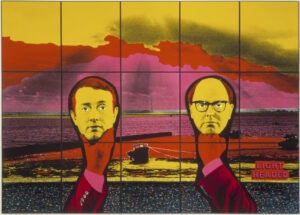
Gilbert & George, LIGHT HEADED 1991. © Gilbert and George. Courtesy of The
Gilbert & George Centre / Photo © National
Galleries of Scotland.
From the first, the two have viewed the art establishment with a mistrust that’s paradoxically proportionate to the reverence with which they regard its counterpart in the corridors of actual power. Wholly sincere in their admiration for Margaret Thatcher and the monarchy, in pieces such as Red Morning Trouble they evince the same sincerity in their fear of a socialism they view as an expression of liberal elitism; a vantage point they took up long before it became politically expedient for populists to do so.
By instinct, I think, the pairing are more popular than populist, in line with their slogan of ‘Art for all’. All the same, and all for that their perspective feels more contrarian than Aryan, the very crudity of Thirst, with its over-determined images of blackness, seemingly transplanted from the stereotypes of an earlier time, invites being read as racist. Their ambiguity is, I believe, at once intentional and accidental, since their approach, essentially humorous, while rooted in the adolescent impulse to paint the taboo Day-Glo – somewhere between the broad toilet-brush strokes of Viz and the archness of Chris Morris – is worn with a Buster Keaton mask of deadpan seriousness.
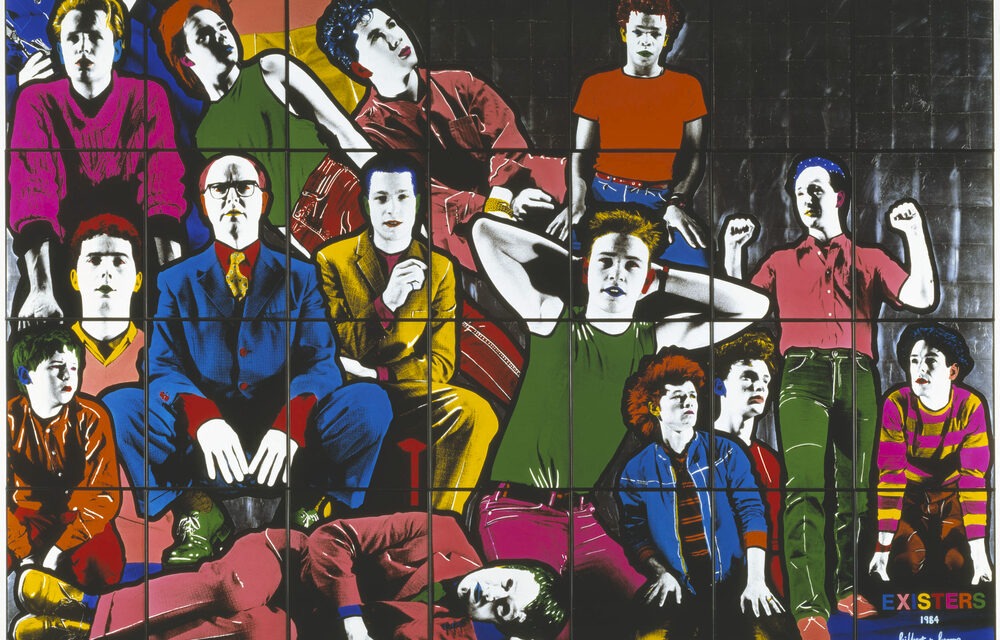
Following the timeline of the exhibition, it’s possible to appreciate the degree to which, over the years, their practice has become increasingly both honed and homed. Through the former process, their work has come to possess the singular quality of being equally unmistakable and inimitable. Constructed at scale, and coordinated, panel by panel, within the structure of a grid, their art can be read as part of Pop’s hangover; part stained glass, part comic strip. As such, they’re accessible, without – at their best – side-stepping complexity. In The Shit, for example, superficial scatology aside, is also affectingly tender. Gilbert & George may well be ankle-deep in faeces, the composition argues, but, hand-in-hand, and though exposed, they’re facing the future.
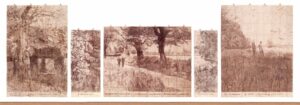
Gilbert & George, The Nature of Our Looking
1970, Tate. © Gilbert and George. Courtesy of The Gilbert & George Centre / Photo © Tate.
Through the homing process, their practice has come to be bounded by their adopted East End, which, in the typical fashion of Londoners, they have come to regard as a microcosm of all there is, and all there possibly could be. Their own Fournier Street manor, in the parlance of the area, is, pleasingly enough, virtually indistinguishable from their own manner. The Nature of Our Looking, their early, monumental charcoal five-piece movingly expressed the wish that “good & bad give way for Gilbert & George to be not in or out of place”, and, perhaps, in their East Side Story they have come to conclude that ‘there’s a place for us’.
As, in their own words, “living sculptures, dying slowly”, there’s a sense in which the artists have always been informed by the limitations of mortality, and consequently have sought to secure a permanence in an establishment of their own choosing, on their own terms. Even beyond their natural home, in Spitalfields’ Gilbert & George Centre, much like monumental graffiti, tagging their times in their signature style, the works of Gilbert & George insist that they were here.
By Desmond Bullen, Chief Arts Correspondent
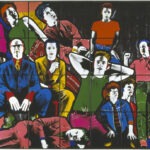
Main image: Gilbert & George, EXISTERS 1984. © Gilbert and George. Courtesy of The Gilbert & George Centre / Photo © National Galleries of Scotland.
Artist Rooms: Gilbert & George is at The Atkinson, Southport until February 27, 2027. For more info, click here.