It’s apt that a being which rose to new prominence in the late 19th century’s age of decadence can best be described with a suitably Wildean paradox: casting no reflection itself, the vampire is nonetheless eternally the mirror of its times.
After resting entombed for centuries, the figure was summoned back into the popular consciousness by Bram Stoker’s classic novel of 1897, and it is Stoker’s Dracula around which the Quite Shameless exhibition at Leeds’ Treasures of the Brotherton gallery pivots.
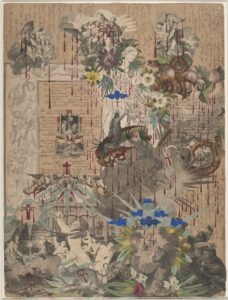
John Bingley Garland, Blood découpage, ca. 1854 Credit: University of Leeds Cultural Collections, Elliott Collection MS Burne Jones.
Spanning the centuries, reaching as far back as William of Newburgh, who, in the 12th century, became the first English writer to chronicle tales of the unquiet dead, the exhibition offers up a kaleidoscope of dark looking glasses, each refracting the vampire archetype at a different angle, some more oblique than others. To be invited over its threshold is to find oneself presented almost at once at some new portal, which in turn suggests a further unopened door, and so on.
And so onward, as it turns out that Sabine Baring-Gould, represented here as the avant la lettre Fortean who collated the werewolf lore that Stoker drew upon in his own research (in the self-explanatory 1865 Book of Were-wolves), not only adopted the proto-Goth approach of teaching with a rescued bat nestled safely on his shoulder, but also found the time to compose the decidedly non-Goth Onward Christian Soldiers.
If Dracula has a genealogy, then it can perhaps be traced back to a poem by Coleridge. His Christabel, a rhyme that hints at both the preternatural and the Sapphic as it animates the presence of Geraldine, the title character’s succubus, seeded more than one exotic bloom. Its first blossoming was in Italy’s Villa Diodati in 1861, as one of the catalysts to an extraordinary eruption of Gothic fiction – the respective tales of Byron, Polidori and especially Mary Shelley darker still than the volcano-blackened skies they were composed beneath. This exhibition showcases the original manuscript of Byron’s incomplete novel, sometimes known as A Burial, as well as a signed edition of Frankenstein, although Byron’s imprint can also be discerned between the covers of Polidori’s The Vampyre; its mad, bad and dangerous protagonist Lord Ruthven being animated by something of his character.
A later bloom, more rare and strange than Dracula, was Sheridan le Fanu’s Carmilla, here serialised within the pages of The Dark Blue, which hot-housed Coleridge’s rhyme and its implied passions into a novel whose heavy breathing exhales the love that dared not then speak its name.
Dracula’s issue, though legion, are perhaps too familiar for representation. Rather, it is the iteration of Stoker’s Count, on the stage of a theatre or performed as a ballet, that Quite Shameless chooses to attend to. Production photos from Northern Ballet’s staging testify to the shape-shifter’s very modern mutability; endlessly reimagined but always unmistakably himself, a Bowie-like pop star staked to the heart of the 19th century.
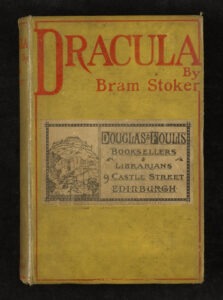
First edition of Dracula by Bram Stoker, 1897. Credit: University of Leeds Cultural Collections.
Nor does Quite Shameless restrict itself to the literary text. Rather, it finds time to set aside the vampire’s glamour to trace a darker, real-world subtext in which sex and contagion, in the decades before vaccination and antiretrovirals, were viewed as holding one another in a deathly embrace. Such anxieties raised their own monstrosities including the mistrust of the other, who carried cholera in their tainted blood, and the forced examinations to which women could be subjected by the Contagious Diseases Act.
As seductive as the Count’s much-vaunted mesmeric powers, Quite Shameless is just the thing for the darkening nights. To look into its mirror is to feel oneself absorbed.
By Desmond Bullen, Chief Arts Correspondent
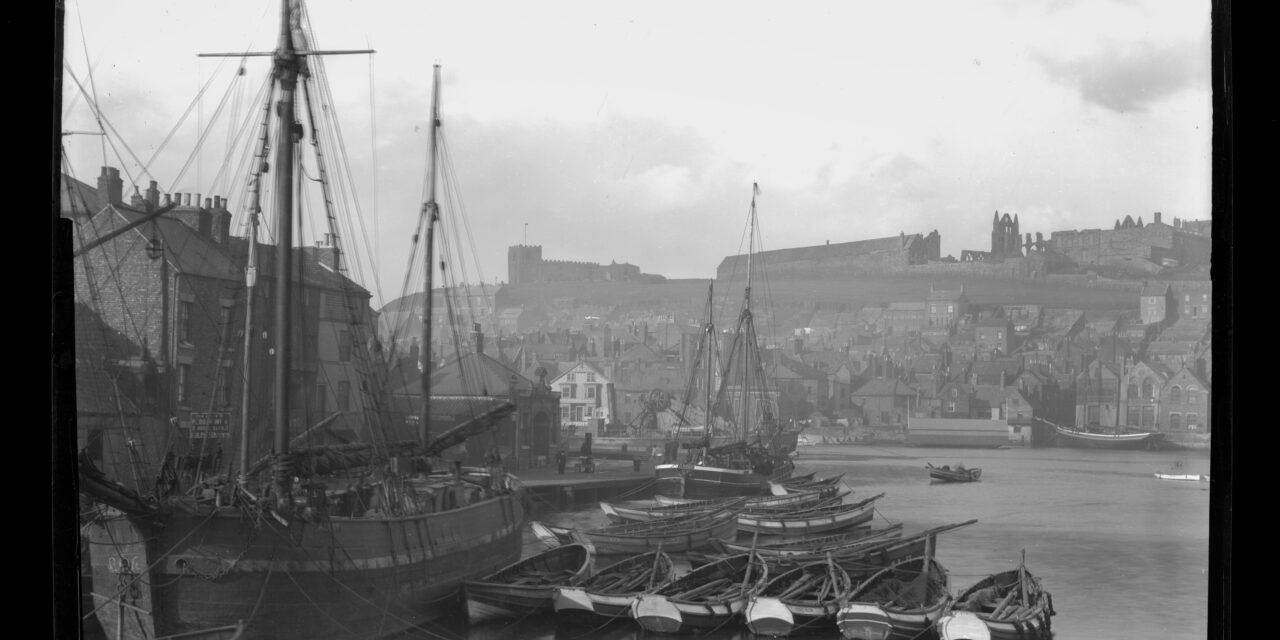
Main image: Whitby, Across Harbour 1896. Credit: Godfrey Bingley Photographic Archive, University of Leeds Cultural Collections.
Quite Shameless: Cultural Reflections on The Vampire is at Treasures of the Brotherton, Leeds until May 29, 2027. For more information, click here.