The English love a posh eccentric.
Romance novelist Barbara Cartland was as posh as they come and more eccentric than most. Even so, were it not for Charles Spencer raking over the ashes of his sister’s memory in time for the Christmas book market, Cartland – Princess Diana’s step-grandmother – might well have been in danger of becoming another fading snapshot in the dusty album of public memory.
Matthew Sweet, however, clearly has other ideas. Afforded unfettered access to an archive as voluminous as her published output, housed, as is Cartland herself, in Camfield Place, Sweet – who was lodged there for part of the writing process – set about writing a life which bookmarked the 20th century with an indelible style that was very much her own.

Matthew Sweet. Copyright: Becky Baker.
For his appearance at Ilkley Literature Festival, Sweet himself is bookmarked, after a fashion, by two of Cartland’s marvellously over-stated frocks (one Norman Hartnell creation bearing the faint impression of gravy stains of roast dinners past) while prompted from anecdote to anecdote by event chair, Liv Chapman. In the face of so extravagant a life, the allotted hour feels far too short. There is barely time to scratch a surface held together by Meltonian shoe cream and vitamins.
Cartland was a believer in both: the boot polish as an alternative to mascara, impervious to tears; the vitamins as a guarantor of the long life which she went on to lead. Nor were these beliefs her most heterodox. Cartland was interested, along with many of her generation, in the esoteric – in the philosophies of figures such as Gurdjieff and Ouspensky – and it’s not too great a stretch of the imagination to wonder how she may have sought solace following the near-simultaneous losses of her two brothers at Dunkirk in the promise of the soul’s survival of earthly demise.
In fact, Cartland credited her prodigious productivity to forces beyond herself. As the title of Sweet‘s biography implies, Cartland had no time for the scratch of pen on paper or the tap of nails on typewriter keys, choosing rather to dictate her novels while reclining on her favoured sofa, often with a Pekinese as her familiar, to a series of women gifted in the art of shorthand. Thus reposed, she purported to view herself as something akin to a spirit vessel, channelling somewhat formulaic emanations from a great beyond which she would sometimes style as God, others as the Fourth Dimension.
It’s easy to revel in this wealth of kitsch surface detail, but Sweet would caution that to do so overlooks both the vast body of work which makes Cartland, to this day, the third most-read author in the English language (after Shakespeare and Agatha Christie) and the readership who responded to it in droves. In common with other forms of popular culture which are derided or dismissed, such as pop music in its least pretentious, most accessible forms, her fan base was, in the main, female.
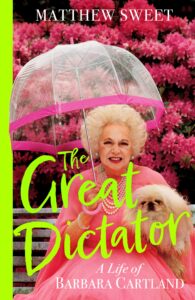
The Great Dictator by Matthew Sweet
While she kept her heroines virginal, at least until the consummatory final chapter, Cartland wrote practically and frankly for this audience, in particular through her grandiloquently-named advice column, All I Want To Do Is Help You, in which she, who had endured delayed consummation in her first marriage, made no bones about the fact that ‘fumbling husbands’ were more often than not at the root of unresponsive wives.
Recently, and rightly, nominated for the Baillie Gifford prize for non-fiction writing, this is The Great Dictator’s great strength; rather than shying away from Cartland’s contradictions, it embraces them, and, in doing so, reveals a woman whose complexities mirror the century she never quite succeeded in making over in her own rather singular image.
By Desmond Bullen, Chief Arts Correspondent
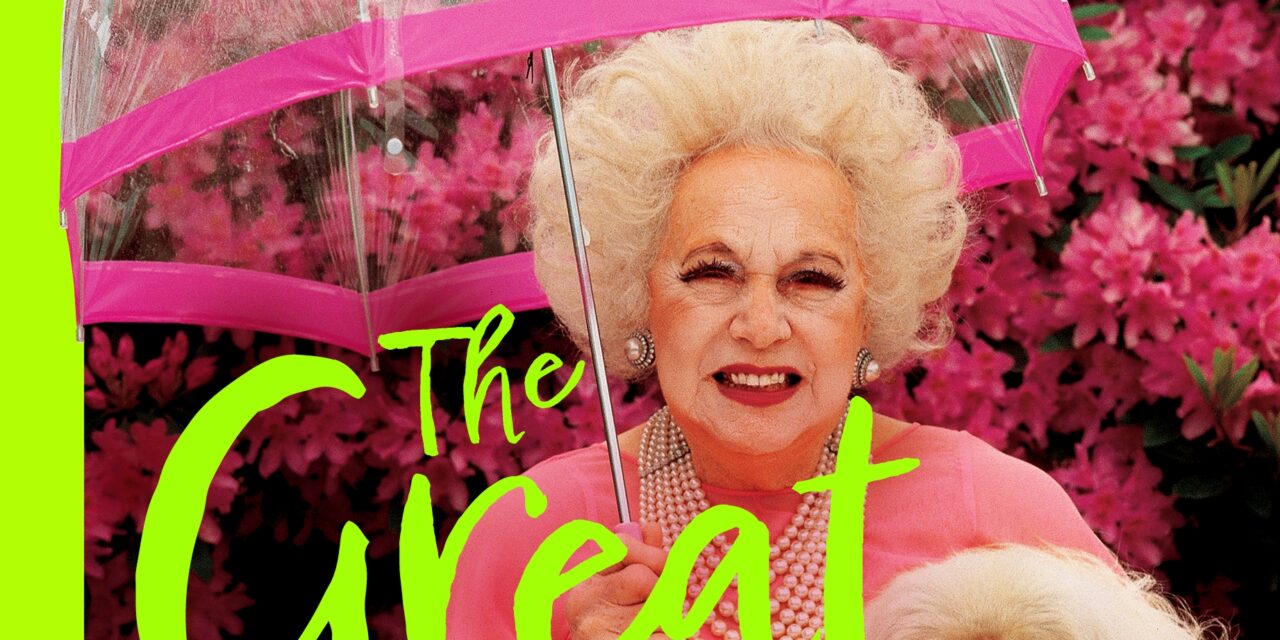
Main image: The Great Dictator by Matthew Sweet