Verdi’s 1851 opera Rigoletto felt suddenly topical at Salford’s Lowry this month.
As debates rage about men’s predatory behaviour, celebrity culture and wider institutional complicity in female suffering, this old tale of moral corruption sees blokeish hangers-on aiding their philandering Duke’s serial sexual assaults on women. Rigoletto himself, a barely tolerated joker in the pack, publicly mocks Monterone, whose daughter is one of the Duke’s recent victims. In Opera North’s welcome revival of Femi Elufowoju jr’s 2022 production, Monterone is sung with magisterial intensity by octogenarian superstar Sir Willard White, and the curse he places on Rigoletto and the Duke resonates through to act three’s bitter conclusion, when Rigoletto’s own daughter Gilda has been seduced herself and her father’s planned revenge on the Duke goes catastrophically wrong.
In British-Nigerian director Elufowoju’s bold retelling of one of opera’s most controversial, complex achievements, issues of corruption are pulled into fresh focus by recasting the Duke’s court as a place where power dynamics are skewed around race. Traditionally, Rigoletto’s physical deformity has been an uncomfortable marker of his moral failing. In this new take, he’s become an able-bodied black man in a largely white court, hyper-vigilant of his difference, acutely aware of his place within and yet not within the system. The American baritone Blake Denson is a versatile Rigoletto with exceptional dramatic range, capturing the character’s ambiguous outsider/insider status and modulating his voice between tones of honeyed gentility, bitter jesting and shattering force with conviction and apparent ease.
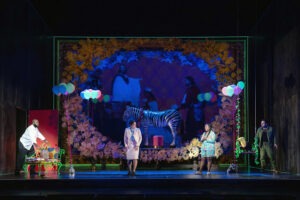
Rigoletto, Opera North. Photo credit: Richard H Smith.
While this is a racist court, it’s also a misogynist one where sex difference matters most, and this presents a challenge to a production so intent on freely reinterpreting Rigoletto’s world. What are we to make of the Duke, a tenor role with some of opera’s most seductive arias? We’ve seen his type before. Almost a century earlier, Mozart’s The Marriage of Figaro and Don Giovanni cornered the market for womanising Lotharios, and Elufowoju’s production knows it. Here, Leonardo Sánchez as the Duke sometimes feels a little underpowered, but he has a winning charm. If this is a Duke who knows how to work his seemingly genial onstage presence sexually, the audience sees through him, for when he sings that Gilda’s heavenliness could possibly turn him into a good man, a lot of us laughed in disbelief. It is a laugh that the production surely anticipates.
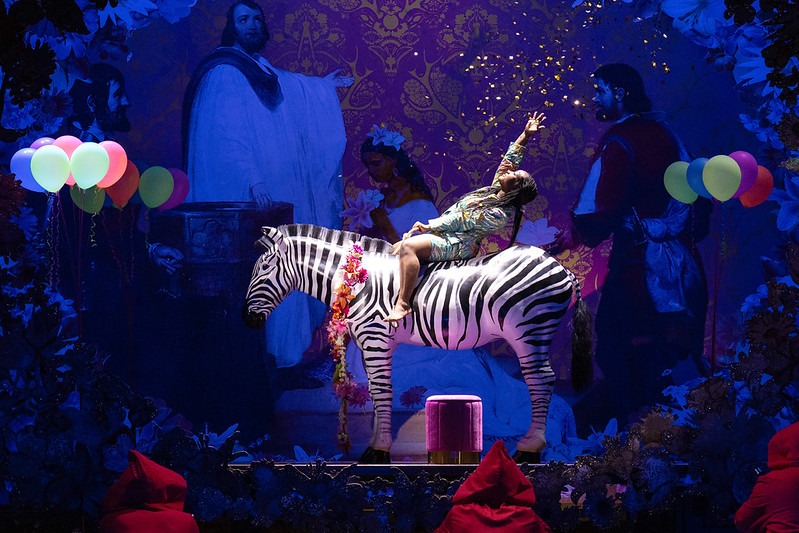
As for Gilda, she too is a stock type: the unworldly ingénue, quasi-angelic, besottedly in love and ready to die for it. Jasmine Habersham hits all of those notes and is technically accomplished, but her Gilda is less convincing as a fleshed-out character. We sense this just as we see through the Duke. His music is ceaselessly mellifluous, hers is sentimentally affecting, yet we’re ironically detached from them both. When she sings her famous aria Caro Nome (Dearest Name), as dreamily gentle and excited an expression of young love as you could get, the designer Rae Smith’s excessively saccharine set shrieks the clichéd, cutesy worldview of winsome girlishness. Balloons here, a swing there, and a life-sized zebra which speaks of her family’s African heritage but is also a My Little Pony toy-shop fantasy writ large. It’s a mark of the production’s deftness that it can sustain this level of sardonic irony while still allowing Verdi’s music to move us directly.
At the end, as the Teflon Duke gets away with his misdemeanours and we hear again his jauntily sexist aria La Donne Mobile (Women are fickle), it’s a final bitter twist in a remarkably accomplished production.
By Andrew Moor, Opera Correspondent
Main image: Rigoletto, Opera North. Photo credit: Richard H Smith.