On March 19, 2026, King Charles III declared the England Coast Path, to which his name was appended in 2023, officially open. For those of us trying to complete the route, it had been a long time coming.
The first section of the path opened between Lulworth and Weymouth in June 2012, but my relationship with this 2,700-mile route began in June 2014 when the first sections in the north opened up. Following a chance conversation with an acquaintance who works for Natural England and was involved in the inception of the route, I had the idea to produce a series of guidebooks. So, I headed off to walk 50 miles along the Durham coast and 30 miles in west Cumbria. I was immediately struck by the variety of scenery on the English coast and its ability to throw up surprises at every turn.
Between Sunderland and Newcastle, there is a series of impressive stacks standing proud of the limestone cliffs. Moving south, the delightful beaches and denes of the Durham coast are backed by reminders of the coal-mining industry that once turned the sand black (think about the final scene of Get Carter).
Moving to west Cumbria, the stretches of coast around Maryport, Allonby and Silloth were new to me. I found this gentle part of the Solway coast to be wonderfully quiet and, as I navigated the lonely dunes, I had a view of Criffel in southern Scotland.
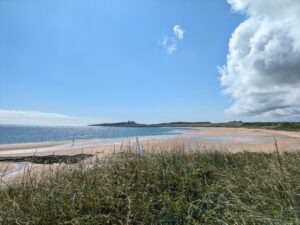
Bamburgh to Craster. Image: Christopher Goddard.
As I headed south, industry dominated the landscape once again around Workington and Whitehaven. What it revealed was quite beguiling. The artificial hill of Derwent Howe is formed of spoil from the Moss Bay Steelworks and, where it has been eroded by the sea, it has formed the most extraordinary cliffs, with arches created in the black waste north of the River Derwent.
This is the great strength of England’s coastal path: a commitment to make the whole coastline accessible. It matters that people in all parts of the country have access to the nation’s shoreline, and hopefully this route will bring more people to some of the underappreciated areas. This brings us back to the present and some of the most recently opened sections, particularly around the intricate peninsulas of south Cumbria. A path between Askham and Sandscale Haws wasn’t officially opened when I was walking it, so there were no visitors, although locals were making great use of the charming new path along the wooded crest above the sands of the Duddon estuary. Dog-walkers and families were enjoying the bluebells, and I realised that the coast path is so much more than an excursion for the long-distance walker.
While I began in the north, finishing my book on the northern coasts has been time-consuming. The justifiably well-known parts of the coasts of North Yorkshire, Northumberland and the Wirral have now been complemented by entirely new paths around west Cumbria, Lancashire and the East Riding of Yorkshire. Though there are still a few gaps in the trail, the whole of the north-east coast is accessible, and you can now enjoy access to the stunning scenery afforded by our coastline. There is no better way to see it than on foot – avoid busy roads and awkward parking for the quiet spaces where the sea opens out and birds soar overhead.
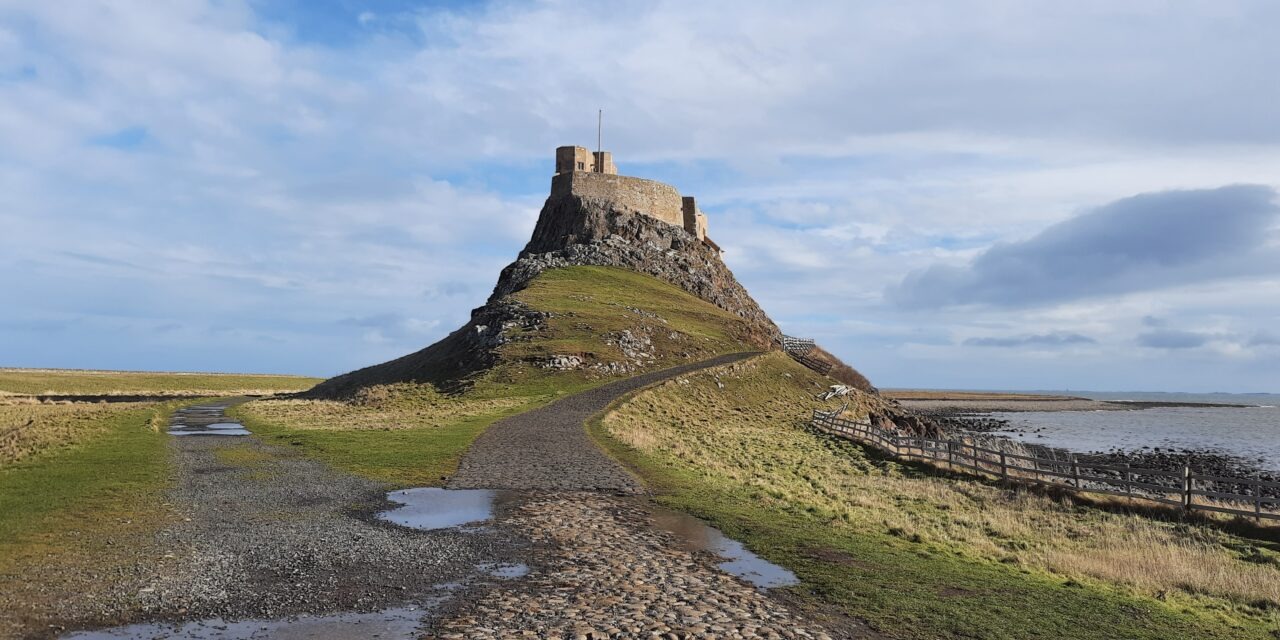
Main image: Lindisfarne. Credit Christopher Goddard
Christopher’s Goddard’s four-book series of the whole of the England Coast Path is available at christophergoddard.net